

Why a Home Elevator is the Ultimate Solution for Senior Mobility
A home elevator provides a highly reliable method for individuals facing mobility challenges to navigate multi-story residences safely. Homeowners increasingly install a private residential lift to ensure long-term property accessibility and comfort. Aging in place requires specific structural adjustments to maintain independence. Stairs present a significant physical hazard for seniors and individuals with joint conditions. Integrating an internal automated transport system eliminates the physical strain of climbing steps daily.
Caregivers also benefit immensely from these installations. Moving wheelchairs, medical equipment, or heavy items becomes a seamless process. Manufacturers build these systems strictly to support independent living without requiring constant external assistance. Modern lift designs integrate smoothly into existing floor plans without demanding massive renovations. Wheelchairs fit easily inside standard cabin dimensions, allowing full rotational movement for the user. Property owners view a home elevator not just as a medical necessity but as a long-term real estate investment. A well-installed lift increases the total market value of the property. Global markets demand these mobility solutions, and a reliable global elevator exporter based in Turkey can supply high-quality systems worldwide.
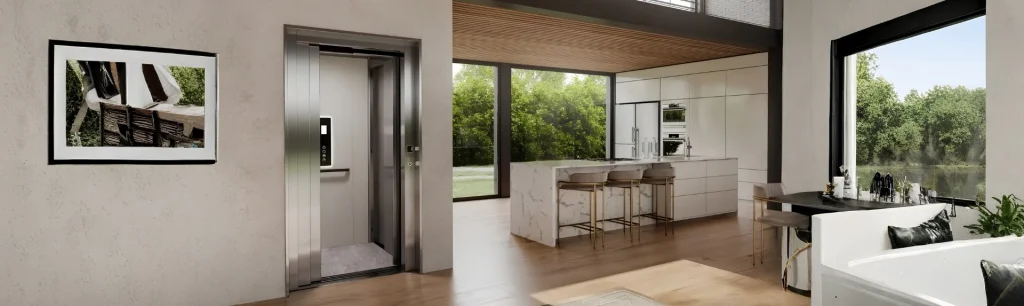
Integrating Space-Saving Home Elevator Designs into Luxury Villas
Architects prioritize floor space optimization when drafting residential blueprints. A space-saving home elevator requires minimal square footage, preserving the open feel of a luxury villa. Older hydraulic systems demanded large exterior machine rooms to house massive pumps and oil tanks. Modern engineering introduces Machine Room Less (MRL) technology to solve this exact spatial problem. Builders install the driving mechanism directly within the shaft. This configuration frees up basement or ground-floor areas for other homeowner uses.
Luxury villas feature custom architectural elements. Lift manufacturers supply bespoke cabins to match specific interior design choices. Homeowners select from glass walls, brushed steel fixtures, and premium wood flooring. European buyers frequently request high-end lift installations that blend invisibly into modern multi-level properties. The integration process requires close coordination between the lift manufacturer and the local construction team. Structural engineers assess the load-bearing walls to ensure safe anchor points for the guide rails.
Supplying lift components from Istanbul to the Middle East and Europe demands high adaptability to various architectural styles. Customization allows homeowners to define the exact dimensions of the cabin based on the available shaft space. Pitless elevator designs eliminate the need to dig deep concrete foundations beneath the ground floor. A shallow depression of just a few centimeters accommodates the bottom mechanics. This approach protects the structural foundation of older villas and historical renovations. The installation team completes the assembly within a few days, minimizing disruption to the household.
Safety Standards for Private Home Elevator Systems in 2026
Regulatory bodies update manufacturing protocols constantly to protect end-users. A private home elevator must meet strict industrial criteria before entering the market. The EN 81-20/50 Standards dictate the exact construction rules and testing procedures for passenger transport systems. Facilities must obtain CE Certification to prove their products comply with European safety and health protection directives. Companies maintaining ISO 9001 certification demonstrate a consistent quality management system across their entire production line.
Critical hardware components include the Speed Governor and the Safety Gear. The speed governor actively monitors the cabin velocity during every trip. If the downward speed exceeds the calibrated safety limit, the mechanism triggers instantly. The safety gear then grips the steel guide rails to halt the cabin immediately. These interconnected mechanisms prevent free-fall accidents under all circumstances.
Power outages pose a concern for residential users. Modern systems incorporate battery backup units. If the main electrical grid fails, the battery engages automatically. The lift descends slowly to the nearest lower floor and opens the doors, allowing passengers to exit safely. Emergency communication devices sit inside every cabin. Users press a designated button to connect directly to an external telephone line or emergency service. Door sensors detect any obstruction during the closing sequence. The automated doors retract immediately if a person or object blocks the threshold. These overlapping safety layers ensure complete peace of mind for families.
Comparing Vacuum and Screw-Driven Home Elevator Technologies
Engineers develop various mechanical drive systems to power residential lifts. Homeowners evaluate these options based on their specific property constraints. Vacuum elevators operate using complex air pressure differentials. A powerful pump reduces the air pressure above the cabin, causing the atmospheric pressure below to push the unit upward. This pneumatic system requires a fully sealed circular tube shaft. The transparent design offers a 360-degree view, but the payload capacity remains lower than alternative methods.
Screw-driven elevators utilize a heavy-duty motor attached to a threaded steel shaft. The motor rotates a large nut that physically moves the cabin platform up or down the thread. This system moves at a slower pace but provides immense lifting power and requires very little shaft space. Builders frequently install screw-driven units in properties lacking a pre-existing concrete lift shaft.
Traditional traction elevators use strong steel ropes and heavy counterweights to move the cabin. The counterweight balances the load, reducing the strain on the electric motor. Modern gearless systems advance this concept further. By eliminating the traditional gearbox, these motors operate directly on the drive sheave. Our gearless systems provide up to 40% energy efficiency compared to traditional models. This massive reduction in power consumption lowers monthly utility bills for the homeowner. The gearless traction method delivers the smoothest ride quality and accommodates higher payload capacities suitable for larger families or heavy equipment.

Quiet Operation Maintaining Residential Peace with a Home Elevator
Acoustic performance heavily influences homeowner satisfaction with automated machinery. A loud industrial motor disrupts the calm environment of a private residence. Manufacturers design the modern home elevator specifically to run silently. Soundproofing materials completely surround the primary drive unit to absorb mechanical vibrations. Engineers apply dampening pads between the motor mounts and the structural walls.
Gearless traction motors operate much quieter than older hydraulic systems. Hydraulic pumps generate significant noise as they force heavy fluid through narrow valves. Gearless electric motors eliminate this fluid displacement noise entirely. Homeowners sleep undisturbed while family members use the lift during the night.
Software controllers manage the acceleration and deceleration curves of the electric motor. Soft-start and soft-stop features prevent abrupt, jerky movements. The cabin glides smoothly away from the landing and slows down gradually before reaching the destination floor. This precise speed control minimizes mechanical clanking and ensures the doors open silently. Polyurethane guide shoe rollers replace traditional hard plastic or metal sliders. These soft rollers grip the steel guide rails firmly but travel up and down without generating friction noise. Acoustic engineers measure the decibel output inside the cabin and the adjacent rooms to verify compliance with strict residential noise limits.
2026 Catalog For Compact Home Elevator Models
Property owners review diverse structural configurations before finalizing a purchase decision. The latest hardware catalog highlights ultra-compact designs engineered for narrow residential spaces. Buyers find highly detailed specifications regarding maximum payload capacity, cabin dimensions, and power requirements. Models range from basic functional units designed for straightforward accessibility to premium custom builds featuring luxury materials.
Consumers compare the distinct advantages of traction, screw-driven, and gearless variants to match their specific architectural needs. Technical data sheets outline the exact electrical draw and maintenance schedules for each model. Finding a reliable manufacturing partner ensures a successful long-term installation.
Guiding the elevator industry since 1977, Merih Asansör is one of Turkey’s leading manufacturers of automatic doors, cabins, and complete elevator systems, distinguished by over 40 years of profound experience, a robust R&D infrastructure, and a 100% domestic production approach. Operating within a 30,000-square-meter state-of-the-art facility with an annual production capacity of 100,000 doors and 5,000 cabins, the company exports its quality, reliability, and innovation-driven solutions to more than 65 countries, successfully representing Turkey’s engineering power in the global market. Clients receive comprehensive technical support, from the initial architectural blueprint phase to the final physical installation of the home elevator. Dedicated engineering teams test every component rigorously to guarantee absolute compliance with international safety directives.